Most professionals don't lose opportunities because they lack skills. They lose them because they leave meetings without a clear record of what was decided, what they committed to, and what they need to follow up on. Meetly addresses exactly that gap.
What Meetly Actually Does in a Meeting
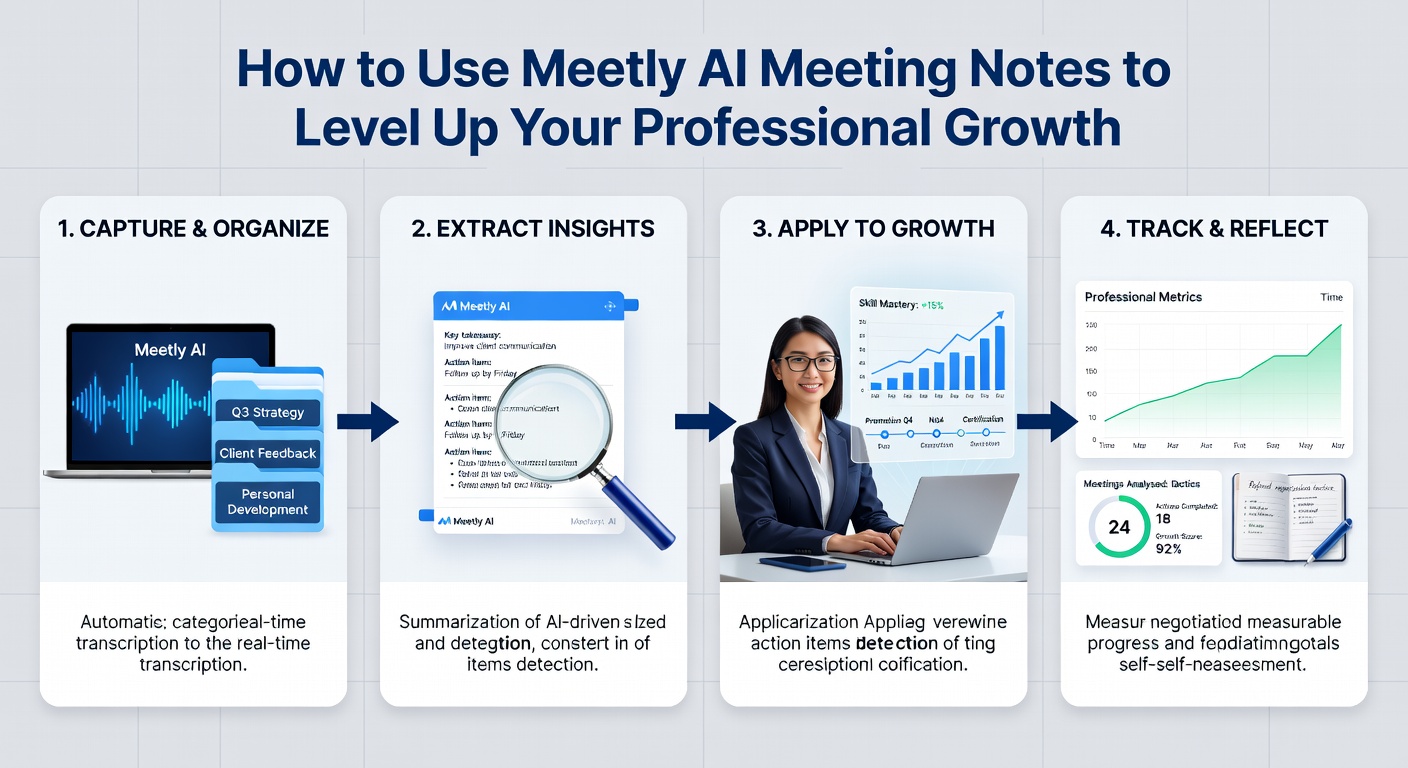
Meetly joins your calls and produces a transcript, a structured summary, and a list of action items — automatically. You're not manually tagging moments or cleaning up notes afterward. By the time the call ends, the record is already there.
The action items are pulled from the conversation itself, not generated from a template. If someone says "I'll send the revised proposal by Thursday," Meetly captures that as a follow-up tied to the right person. That specificity is what makes it useful rather than decorative.
Where It Connects to Professional Growth
Growth in most roles comes down to a few things: following through reliably, contributing visibly, and building on past context. Meetly creates a paper trail that supports all three.
A few concrete scenarios where this shows up:
- Performance reviews: You can pull up a record of every project discussion, decision you influenced, and commitment you delivered on. That's harder to do when your notes are scattered across a notebook and a few Slack threads.
- Cross-team collaboration: When you're working with people outside your immediate team, having a shared summary after each call reduces misalignment and keeps everyone accountable — including you.
- Onboarding and ramp-up: New to a role or a project? Meetly notes from early calls give you a reference point to revisit without having to ask the same questions twice.
- Managing up: When your manager asks for a status update, you have a structured log of what was discussed and what's in progress. You're not reconstructing from memory.
Honest Tradeoffs to Consider
Meetly works best when your meetings have some structure — a clear topic, identifiable speakers, and actual decisions being made. Casual brainstorms or exploratory conversations produce messier output, and the action items may need manual cleanup.
It also requires that participants are comfortable being recorded. In some team cultures or client contexts, that's a non-issue. In others, it needs a conversation first. Worth thinking through before you roll it out broadly.
If your goal is purely personal note-taking and you prefer full control over how information is organized, a manual system might still suit you better. Meetly's value is in automation and consistency — if you already have a reliable process, the marginal gain is smaller.
Getting the Most Out of It
The professionals who benefit most from Meetly tend to do one thing consistently: they review the summary right after the call and act on the action items the same day. The tool does the capture; the follow-through is still on you.
Sharing the summary with other attendees also changes the dynamic. It signals that you're organized, closes the loop on what was agreed, and reduces the back-and-forth that usually follows a meeting with no written record.
Used that way, Meetly isn't just a note-taking tool — it becomes part of how you show up professionally, call after call.
Comments
Leave a Comment