Every remote worker I know has the same complaint: "I spend half the meeting writing down what was said and the other half trying to actually participate." The note-taker paradox is real—the more detailed your notes, the less present you are. And if you're the one person who doesn't take notes? Someone's action item gets lost, and you're the one chasing it down two days later.
I've tried the obvious workarounds. Recording the call and transcribing it yourself? That's an hour of manual cleanup. Passing the note-taking duty to someone else? Passive-aggressive Slack messages incoming. Relying on memory? Please.
This is exactly the scenario that made me test Meetly Notes. Their tagline—"Focus on Talking, Meetly Handles the Rest: Effortless Meeting Notes"—sounds nice, but I wanted to see if it actually delivers on the "effortless" part or if it's just another transcription tool that buries you in raw text.
What Meetly Actually Does With Your Conversation
The core promise is straightforward: you join a meeting, Meetly listens, and afterward you get a transcript, a summary, and a list of action items. No bot joining the call as a participant (though it can if you prefer), no complex setup per meeting. You install the integration once, and it runs silently.
On a practical level, this solves the most annoying part of meeting admin—the post-meeting scramble. You know the one: the call ends, everyone says "I'll send notes," and nobody does. Or someone sends a massive wall of bullet points that takes ten minutes to scan. Meetly's summary is structured from the start: key points, decisions, who is responsible for what. It's not magic, but it saves the ten-minute scan.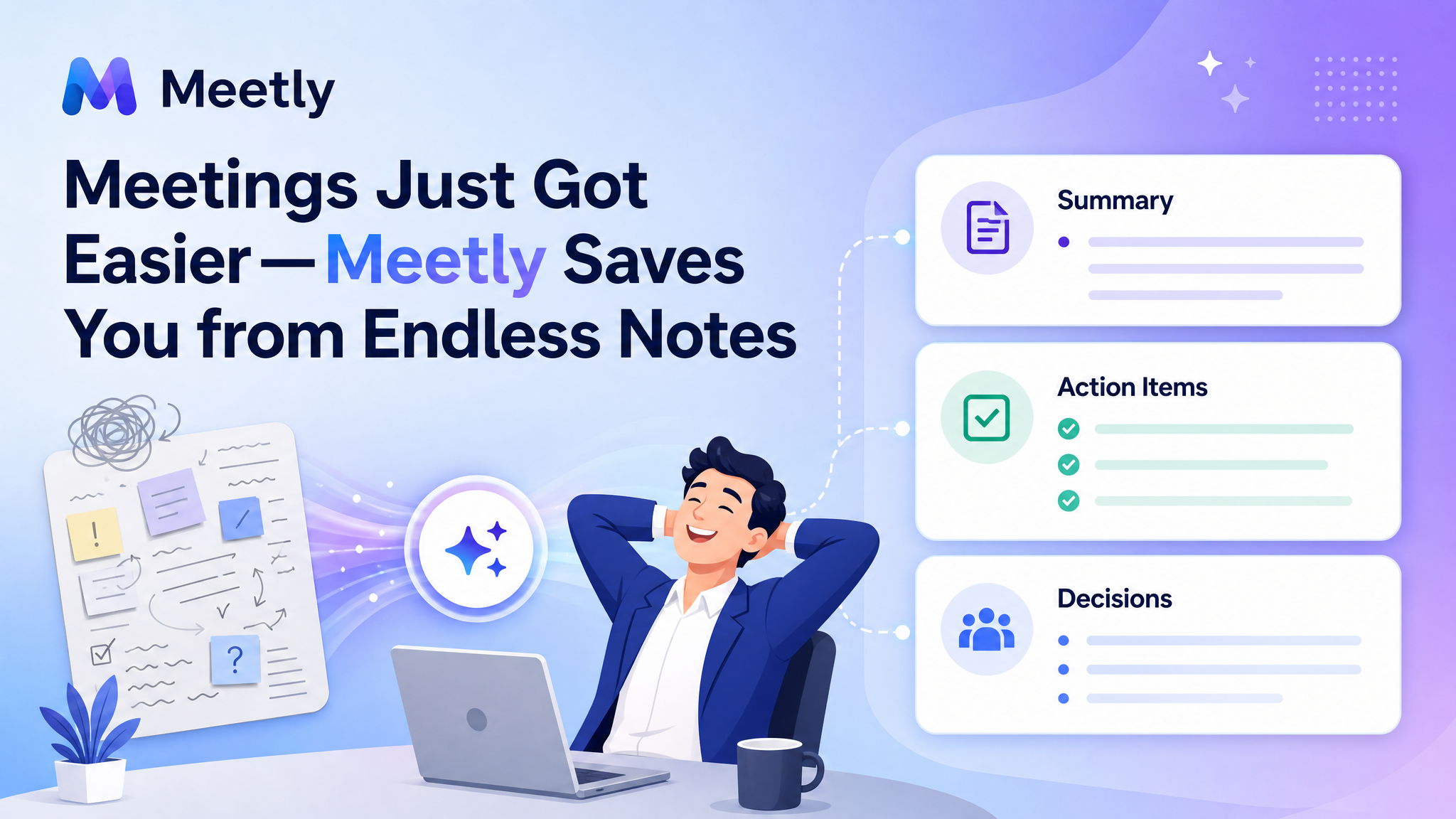
Real scenario I tested
Weekly product review with six people, 45 minutes, normal chaotic discussion. Meetly's output was a one-page summary with four action items, correctly attributed to three different people. One action item was vaguely worded ("look into the API limits again"), but that reflects how the conversation went—the tool can only work with what people actually say. The transcript was searchable, which helped when someone claimed they "definitely mentioned" a deadline. (They hadn't.)
Where It Works vs. Where It Wobbles
Meetly shines in recurring team calls where the format is predictable: standups, sprint reviews, client check-ins. The tool learns the context over time, and the summaries get tighter. For one-off meetings with new external participants, it's still useful but the summaries can feel generic—it doesn't know yet which details are critical to your team.
The accuracy depends heavily on audio quality. I tested it on a call where one participant was on a bad hotel Wi-Fi. Meetly handled it better than I expected, but the transcript had gaps around that person's contributions, and the summary naturally under-weighted their input. That's not a tool flaw—it's physics. But if your meetings routinely include people on terrible connections, be ready to manually fill some blanks.
Action item extraction is impressive but not perfect. Meetly is good at catching explicit statements like "I'll send the document by Thursday." It's less good at implied tasks. "Someone should update the spec" doesn't get assigned, because nobody's name was mentioned. That's the right behavior—better to miss an implied task than to hallucinate an owner. But it means you still need to be explicit in how you delegate during the call.
Should You Ditch Your Current Note-Taking Setup?
If you're currently the person who takes manual notes in every meeting, yes, Meetly frees you. The trade-off is that you lose the physical act of note-taking as a memory aid—some people genuinely remember better when they write by hand. Pairing Meetly with your own quick personal notes (just key numbers or decisions) is a decent middle ground.
If you're using a free transcription tool and then manually cleaning it up, Meetly's summary feature is the upgrade. The time saved is in the structuring, not just the transcription. Many free tools give you raw text; Meetly gives you a meeting artifact you can forward to someone who wasn't there and they'll get it in 30 seconds.
The pricing is reasonable for a team, possibly overkill for a solo freelancer who has one client call per week. For context: if you're in 5+ hours of meetings per week, the time savings easily justify the cost.
Focus on Talking, Meetly Handles the Rest: Effortless Meeting Notes isn't just marketing copy—it's an accurate description of the experience once you're past the initial integration. The first meeting feels weird because you're not taking notes and your hands are free. By the third meeting, you notice you're actually listening more. That's the point.
Comments
Leave a Comment