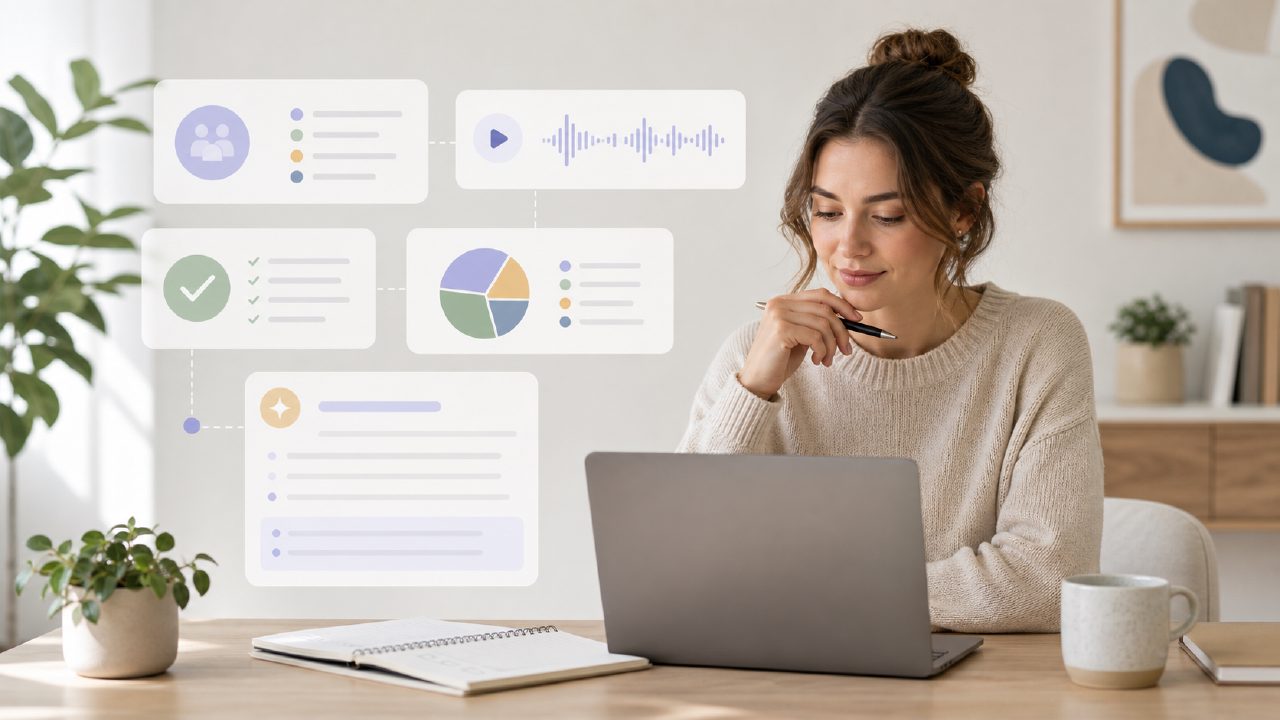
If you’ve ever come out of a meeting and immediately forgotten who was supposed to do what, you’re not alone. I spent last month testing a handful of tools that promise to fix that, including a newer option called meetly. The goal was simple: see if any of them could actually save time instead of just generating more noise. Here’s what I found, organized as a practical checklist for anyone evaluating a meeting summary tool right now.
A quick checklist for evaluating a meeting summary app
Not all AI meeting tools work the same way. Some are great at transcription but terrible at extracting real action items. Others clean up the audio but miss who said what. Based on my testing, here are the main things to look for:
How good is the transcript accuracy?
Meetly handled medium-sized calls (up to 8 people) with solid accuracy. It didn’t get every mumbled word right, especially when multiple people talked over each other, but it correctly attributed speakers most of the time. That’s a lot better than some older tools I’ve tried that just label everyone “Speaker 1” or “Speaker 2” for the entire recording.
Does the summary actually capture what matters?
I tested meetly on a few internal stand-ups and one longer client review. The summary for the stand-up was fine—clear points, no filler. But the client meeting summary surprised me. It picked up the key objections and follow-up commitments without me having to edit much. The summary was about three paragraphs long, which felt right.
Are the action items truly tied to owners?
This is where I’ve seen a lot of tools fall apart. They’ll list action items but not clearly state who owns them. Meetly was better than average here. It pulled out phrases like “John will update the timeline” and put them into a small checklist. I did have to correct one item where it assumed “we” meant everyone, but that was a quick fix.
How fast does it process?
Most free and low-cost tools make you wait several minutes after the call ends. Meetly processed a 45-minute recording in about two minutes. That speed matters when you’re multitasking between back-to-back calls.
What’s the free tier limitation?
This is worth noting. The free version of meetly gives you a certain number of minutes per month, which is typical. For someone with 10 or fewer meetings a week, it probably works. But if you’re in back-to-back client calls all day, you’ll run into the limit faster than expected. That’s a realistic tradeoff unless you upgrade.
One tradeoff that caught me off guard
I half-expected meetly to struggle with heavy jargon or industry-specific terms, and it did, a little. In a design review, it kept writing “wire from” instead of “wireframe.” That kind of error is common across most tools, but it’s worth mentioning because it means you can’t fully rely on the raw output. The summaries were good enough, but the transcripts needed a light proofread if the conversation got technical.
Where I’m still a little unsure
I only tested meetly on English-language calls. If your team works in multiple languages or mixed-language meetings, I can’t say how well it performs. The documentation mentions English-first support, but I didn’t push it on that front. I’d need another week of testing before recommending it for multilingual conversations. That cautious note feels honest.
Bottom line
If you’re searching for the best free ai meeting summary app, meetly is worth putting on your shortlist. It’s not perfect—the jargon handling and free tier limits are real friction points—but the speed and decent action item extraction make it useful for everyday stand-ups and client catchups. I’ll probably keep using it through early 2026 as a lightweight alternative to heavier tools, but I wouldn’t call it a final solution for power users who need deep analytics or high transcription volume.
Comments
Leave a Comment