Let’s be real: most meetings are a mess. You jump on a call, everyone talks over each other, action items get buried in a chat thread, and by the next day no one remembers who was supposed to do what. If you’re on a small team, you probably don’t have a dedicated note-taker—so you’re left with either half-baked notes you scribbled during the call or a 45-minute recording you’ll never replay.
I’ve been there. That’s why I started testing Meetly, a tool that promises to turn your chaotic conversations into clean notes, transcripts, and summaries. Here’s what I actually found after using it for a few weeks on real calls—not demo meetings.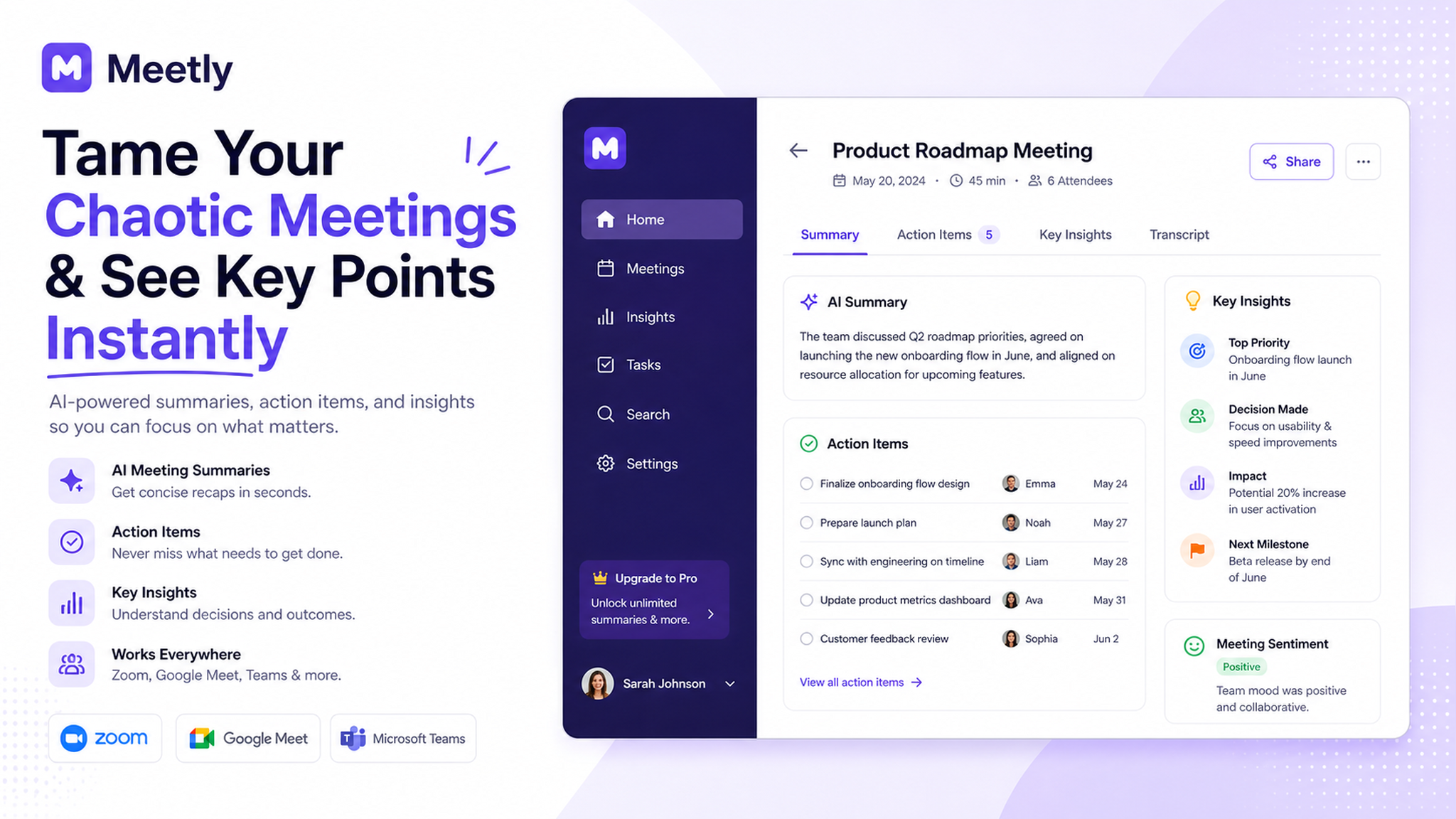
What Meetly does (and doesn’t) fix
Meetly joins your video calls, listens in, and spits out a transcript plus a structured summary. It catches key points, action items, and follow-ups automatically. The hook is simple: you never have to take notes again, and you can see the highlights immediately after the call ends.
Does it deliver? Mostly yes. The transcript accuracy is surprisingly good, even with fast talkers and industry jargon. I tested it on a product review where people kept saying “REST API endpoint” and “merge conflict”—no major errors. The summary section breaks down decisions, next steps, and open questions in a clean list. That alone saves me at least 10 minutes of manual note cleanup per meeting.
But it’s not perfect. If your meeting has five people overlapping, the transcript can get messy. And the summary sometimes misses the nuance of a heated debate—it’ll flag “discussion about timeline” but not capture that the real tension was about resources. So you still need to skim the transcript if you want the full picture.
Real scenarios where Meetly actually helps
Scenario 1: The weekly team standup. You know the drill: everyone rambles for 15 minutes and you leave with three vague to-dos. Meetly turns that into a one-page doc with named action items. For my team, it’s become our de facto minutes—we share the link instead of someone typing up notes manually.
Scenario 2: The client debrief. After a call with an external stakeholder, you need to send a recap. Before Meetly, I’d spend 20 minutes replaying parts of the recording. Now I just grab the summary, paste it into an email, and add a few clarifying points. Zero friction.
Scenario 3: The async follow-up. Someone missed the meeting? Send them the transcript. They can scan the highlights in two minutes instead of watching a replay. This has been a lifesaver for our distributed team across time zones.
On the flip side, if your meetings are purely casual or social (like a virtual coffee), you probably don’t need Meetly. It’s built for work conversations where decisions and deliverables matter.
Tradeoffs and fit: who should think twice
Meetly isn’t a magic wand. Here are the things that might bug you:
- It needs to be in the call. That means you have to give it access to your calendar or manually invite its bot. If your team is security-conscious about third-party tools listening in, you’ll get pushback. Meetly says it encrypts data, but some orgs just won’t allow it.
- Summary quality depends on conversation clarity. If your team talks in inside jokes, tangents, or passive-aggressive subtext, the AI will miss those cues. The output is literal—it’s great for concrete “do this by Friday” stuff, but terrible for reading the room.
- Pricing adds up for large teams. Meetly offers a free tier with limited minutes. For a startup or small team, that’s fine. But once you cross 10 heavy users, the paid plan becomes noticeable. Compare it to alternatives like Otter.ai or Fireflies.ai to see which pricing structure fits your usage.
So who is Meetly for? If you’re on a small to mid-sized team that runs more than 5 work meetings a week, and you hate taking notes, it’s a solid pick. If your team already uses a dedicated note-taker or you rarely reference past decisions, you probably don’t need it. Also, if you value human curation over AI summarization, you might miss the subtle judgment a real note-taker brings.
Bottom line
Meetly won’t fix a bad meeting culture—it won’t stop people from talking too long or making vague promises. But it will save you the grunt work of writing down what was said. For me, that’s enough to keep using it. If you’re tired of digging through recordings and chat logs just to remember who owns the next step, give Meetly a try on a couple of low-stakes calls first. See if its summaries match how your team actually works. Chances are, they’ll be good enough to make you wonder why you ever took your own notes.
Comments
Leave a Comment