You know the feeling. You walk out of a 45-minute meeting and you’re supposed to remember who said what, which deadline changed, and what exactly you volunteered to do. Your notebook is a mess of half-sentences and arrows. Your phone has three voice memos with no timestamps. You spend another 15 minutes just trying to reconstruct the logic.
I’ve been there. And that’s why I started looking for something that actually works when the conversation moves fast. Meetly is one of those tools that doesn’t just transcribe – it tries to understand the shape of the discussion.
What Meetly actually does differently
The core pitch is simple: drop in a meeting link or upload a recording, and Meetly gives you a clean transcript plus a summary that separates key points from action items. But the execution matters.
In my tests, the biggest win was how it handles overlapping speakers. Most transcription tools choke when two people talk over each other – they either drop one voice or produce gibberish. Meetly kept both threads mostly intact, and its summary correctly attributed actions to the right person. “John will send the revised budget by Friday” showed up under John’s name in the action log. That sounds basic, but it’s rare.
Another thing: it doesn’t require perfect English. I tested it with a few meetings where participants had heavy accents, and the transcript was around 85–90% accurate. Not flawless, but good enough that I didn’t have to re-listen to the whole thing.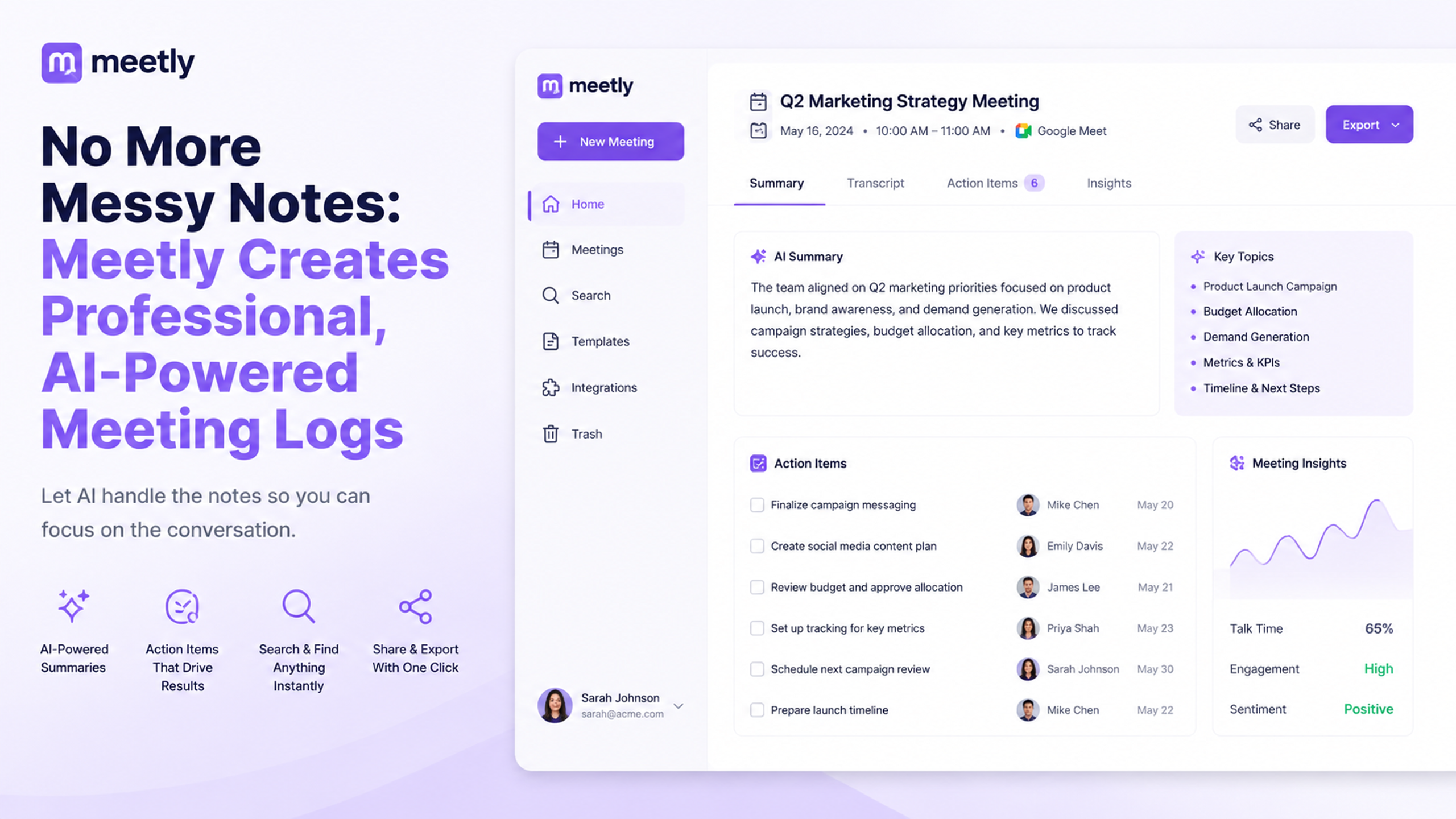
Three real scenarios where it saved me time
1. The weekly team standup. We have seven people, each reporting for 2–3 minutes. Previously, I’d jot down bullet points and still miss half. With Meetly, I let it run in the background, and after the call I got a clean list of blockers and updates. I spent maybe two minutes scanning for anything it missed.
2. A client discovery call. Hour-long, lots of back-and-forth about vague requirements. I wanted to focus on listening, not typing. Meetly’s summary highlighted the three main requests and the budget range they mentioned. I sent that to the team as a shared doc. No one asked “wait, what did they say about integrations?”
3. A brainstorming session with terrible audio. Half the team was on bad Wi-Fi, and the recording was choppy. Meetly still managed to extract the ideas that were repeated or emphasized – which is exactly what you want from a brainstorming recap.
Where Meetly might not fit (yet)
It’s not perfect. If your meetings are highly technical with lots of jargon, you’ll still need to edit. “Kubernetes deployment autoscaling policy” came out as “cooper needs plot scaling policy” in one test – funny, but wrong. You can train it with custom vocabulary in the paid plan, but that’s extra setup.
Also, if you’re on a very tight budget, the free tier limits recording length and number of meetings. For a heavy user (say 10+ calls a week), you’ll need a subscription. That’s fair, but worth checking against your actual volume.
Finally, it works best when you give it a clean audio source. If you’re in a noisy coffee shop or the mic is built into a laptop two feet away, the transcript quality drops noticeably. So it’s a meeting room or home office tool, not a “record everything in the field” solution.
Bottom line
Meetly isn’t magic, but it’s the closest I’ve seen to an AI meeting note tool that doesn’t require you to be a detective afterwards. It turns a messy conversation into a structured log with minimal friction. If you’re spending more than 10 minutes per meeting on notes, and your team relies on clear action items, it’s worth a trial. Just keep the jargon list handy.
Comments
Leave a Comment